Our Lady of the Pillar: The Mother Who Met a Discouraged Apostle
Picture a missionary who has crossed half the Roman world to preach the Gospel, only to find that hardly anyone is listening. That is where Spanish tradition places St. James the Greater around the year 40, in the Roman city of Caesaraugusta, today’s Zaragoza. Tired and disheartened, he went to pray by the River Ebro, and, the tradition says, he did not pray alone.
Every October 12, Catholics in Spain, the Philippines and across the Hispanic world remember what happened next on the feast of Our Lady of the Pillar (Virgen del Pilar). Here is the story, what history can and cannot tell us about it, and why it still speaks to anyone who has ever felt like giving up.
The Story of Our Lady of the Pillar
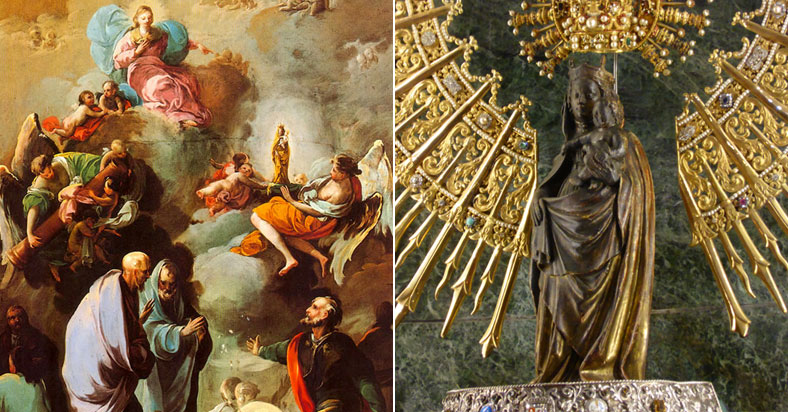
According to the tradition, James, one of the Twelve and the brother of St. John, had carried the faith to Roman Hispania. The harvest was small. On the night of January 2 in the year 40, while he prayed on the riverbank with a few disciples, the Virgin Mary appeared to him in a blaze of light, surrounded by angels.
What makes the account unusual is that Mary was still living on earth at the time, in Jerusalem. Tradition therefore describes the event as a bilocation: she was present to James in Spain without leaving the East. She stood on a pillar of jasper, encouraged him to keep going, and asked that a chapel be built on that very spot. The pillar itself was to remain as a sign.
James and his companions built a small chapel around it. He later returned to Jerusalem, where King Herod Agrippa had him put to death, making him the first of the apostles to be martyred (see Acts 12:1-2).
Tradition and History: What Can We Say?
It is worth being honest here, because honesty is part of loving the faith well. Our Lady of the Pillar is a venerable tradition, not a doctrine, and the Church has not formally approved it the way it has recognized some later apparitions. The devotion has been embraced for centuries, however, and the shrine in Zaragoza has been raised to the dignity of a basilica.
The written record also comes much later than the year 40. The oldest written testimony of devotion to Mary in Zaragoza usually cited dates to 1155. Documents mentioning the pillar appear in the late Middle Ages, and the fuller story of Mary appearing to St. James in the flesh was set down in writing later still. Historians continue to debate how much of the tradition can be traced to the first century, and some scholars even question whether James reached Spain at all. Others point out that a church dedicated to Mary already stood on this site long before the Middle Ages.
For a Catholic, the question is not “Must I believe every detail?” but “What does this devotion help me see?” Pious traditions like this one are not required articles of faith. They are gifts that can draw us closer to Christ through his Mother.
The Pillar and the Basilica Today
The pillar is real, and you can still venerate it. It is a column of jasper about 1.77 meters (roughly 5 feet 10 inches) tall, encased in bronze and silver, with a small portion left exposed at the back of its chapel. Pilgrims pass by one at a time and kiss it, a custom that has lasted for centuries. The statue of Mary and the Child Jesus that stands on top is usually dated by historians to the 15th century, and it is often dressed in a mantle (manta) donated by a country, a city or a devoted family.
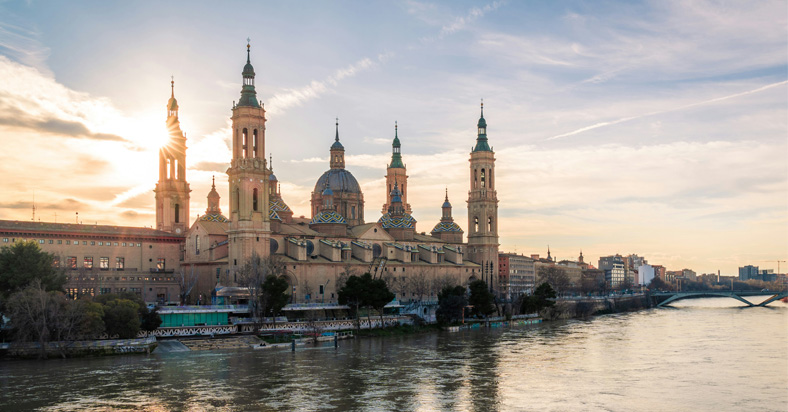
Around it rises the Basilica of Our Lady of the Pillar, built in the Baroque style from 1681 and largely completed by 1730. It has eleven colorful tiled domes and ceiling frescoes by the painter Francisco Goya. St. John Paul II, who visited as a pilgrim, called Our Lady of the Pillar the Mother of the Hispanic Peoples, and she is honored as patroness of the Hispanic world.
The Bombs That Did Not Explode
One of the best-loved episodes in the shrine’s history happened in August 1936, during the Spanish Civil War. Bombs were dropped on the basilica and the area around it. Accounts differ on the exact number, but the bombs that struck the building did not explode. Some of them are still displayed inside, and many of the faithful have seen this as a sign of Mary’s protection over the shrine.
Our Lady of the Pillar in the Philippines
Filipino Catholics have their own reasons to love this title, since the devotion arrived with Spanish missionaries and settlers. Fort Pilar in Zamboanga City, built by the Spanish in the 1630s, was named in her honor and is now an outdoor Marian shrine; she is the patroness of Zamboanga City and its archdiocese. Our Lady of the Pillar is also the patroness of the Diocese of Imus in Cavite, and Santa Cruz Parish in Manila holds a novena and Mass for her feast each year.
What Our Lady of the Pillar Teaches Us Today
- Discouragement is not the end of the mission. James believed his work had failed. Mary’s visit, in the tradition, was a reminder that God sees fruit that we cannot yet see.
- She comes to people who keep praying. James was at prayer, not at the height of success, when he received this consolation. Faithfulness in dry seasons is never wasted.
- Faith needs a steady center. A pillar does not move when the wind blows. In family life, a steady rhythm of prayer, such as a family Hail Mary on October 12, can keep a household standing when feelings and circumstances shift.
If you would like to read more Marian reflections on our site, see Our Lady of Guadalupe: A Miraculous Encounter That Transformed a Continent and The Humility of the Blessed Virgin Mary: A Pathway to Divine Wisdom.
Trivia
When is the feast of Our Lady of the Pillar?
The feast is celebrated every year on October 12. Tradition places the apparition itself on January 2, in the year 40.
Where is the pillar today?
It is in the Holy Chapel inside the Basilica of Our Lady of the Pillar in Zaragoza, Spain, on the banks of the Ebro River.
Is Our Lady of the Pillar an approved apparition?
It is a long-standing pious tradition rather than a formally approved apparition. The devotion has been widely accepted, but Catholics are not required to believe it as a matter of faith.
Why is she called “of the Pillar”?
The name comes from the jasper column on which Mary is said to have stood when she appeared to St. James. The Spanish word pilar means pillar.